Why drivers leave small fleets
He says the new job pays fifteen hundred more, and you would have paid it. The decision was made six months earlier, out of small and inexpensive things.
The driver who has been with you four years tells you on a Tuesday that he is joining a hotel's transport desk from the first. You ask what they are paying. It is fifteen hundred more a month.
You would have paid the fifteen hundred. He knows that. It was never really about the fifteen hundred.
The money is the reason he gives, not the reason he goes
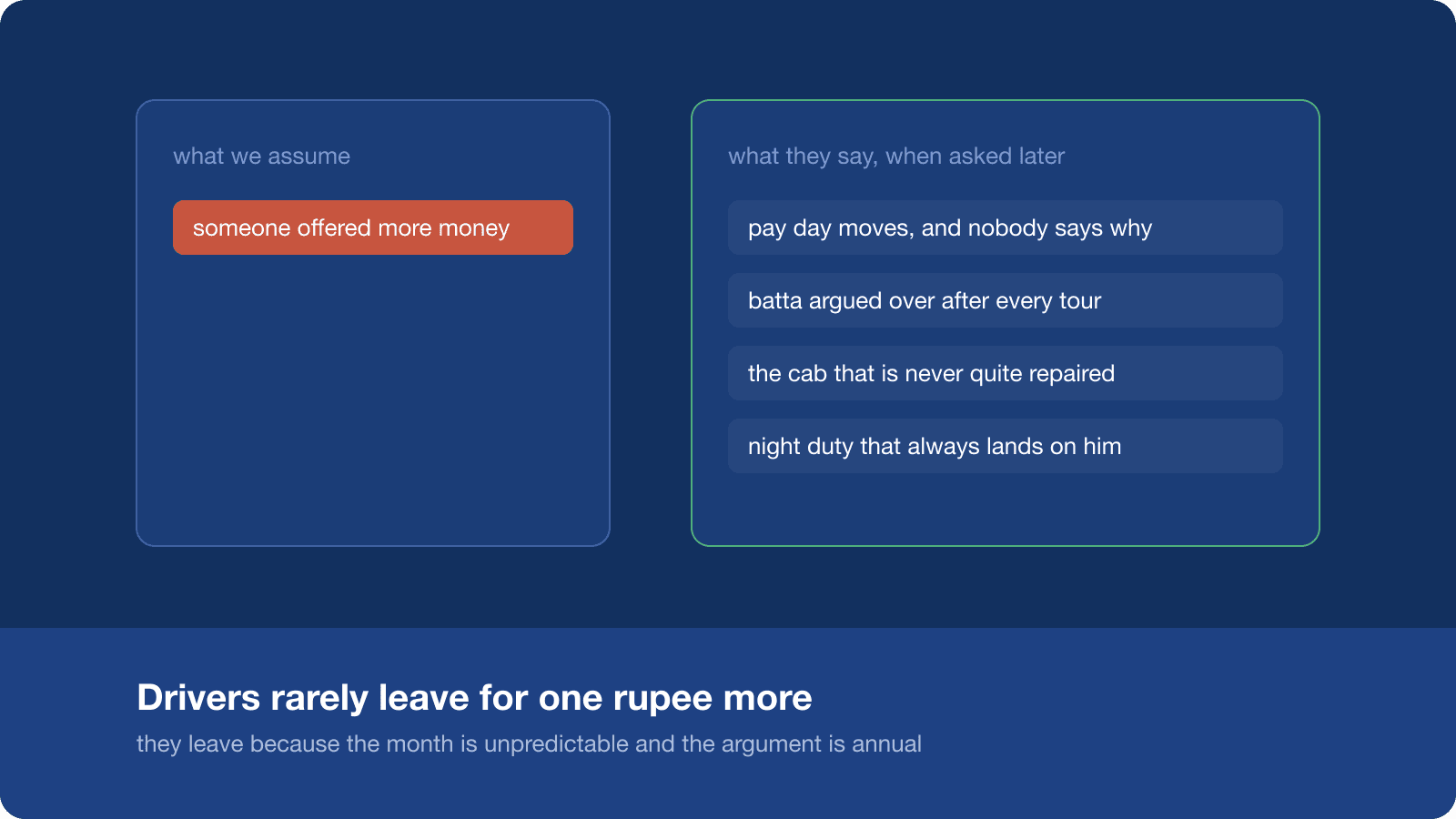
Fifteen hundred is what makes the decision easy to explain, to you and to his family. What made the decision is usually six months old and made of small things, and if you ask him honestly a year later over tea, the list is remarkably consistent across the whole trade.
Pay day that moves. Batta that gets argued about after every outstation tour. Deductions he discovers on the 5th. A cab with a rattle he has reported three times. And the night duty that always seems to land on him, because he is the one who never says no.
None of those is expensive to fix. All of them are about whether the month is predictable.
Predictability is the thing you are actually selling
A driver's life runs on a thin margin, the same as the business does. He has a school fee on a date, a rent on a date, and a family that asks what came in this month. A wage that arrives on the 5th every single month, at a figure he could have worked out himself, is worth more to him than a higher wage that arrives somewhere between the 5th and the 9th, at a number he cannot predict.
This is the part operators consistently undervalue, because from the office the four-day delay looks administrative. From the other side it is a phone call to a landlord.
The annual argument is remembered longer than the annual raise
Every unsettled batta, every advance neither of you wrote down, every deduction that came as a surprise, is a small dispute in which he has no evidence and you do. He loses those arguments even when he is right, and he knows he will lose the next one too.
It costs nothing to write down the rules once, and it costs nothing to record an advance at the moment the cash leaves your hand. What it buys you is the absence of those conversations, and the absence is what he will describe to the next man who asks whether you are a good operator to drive for.
The cab is his workplace
He spends twelve hours a day in it. A seat that has gone, an air conditioner that only works at speed, a horn that sticks, a tyre he does not trust on the highway at night. He raises these because they are his working conditions, and when nothing happens he stops raising them, which is worse.
Fixing the rattle is also cheaper than the alternative, because the driver who stops reporting faults is also the driver who stops noticing them.
What replacing him actually costs
Not the difference in salary. The cab stands for a few days while you find somebody. The new man does not know the client's gate procedure, the shorter route to the plant, or which guard to ask for, so the first fortnight has small failures in it, all of them visible to a corporate client who had grown used to the same face. And for a month you are carrying somebody whose driving you have not seen at night, in rain, with a family in the back.
Against that, fifteen hundred a month looks like a rounding error, which is exactly what it was.
The five things that hold people, cheaply
Pay on the same date every month, without being asked. Write down the batta rules once, at hiring. Record every advance when it is given and let him see the running figure on any day he asks. Repair the cab when he reports it, or tell him when it will be repaired. Rotate the night duties, so that being reliable is not a punishment.
None of that is a retention policy. It is just the difference between a month he can predict and one he cannot.
Where this sits in TripSetu
The driver record holds the pay basis, salary or per-trip, with the night charge and the day's allowance, and the advances drawn sit against the same record. So the figure at month end is produced rather than negotiated, and it can be shown to the driver on the 2nd instead of defended on the 5th. Duties sit on the same calendar as everything else, which makes an uneven night roster visible before it becomes a resignation.
The rest of what the fleet section covers is on the features page, or bring one driver's last three months to a demo and we will reconcile them with you.
Frequently asked questions
Why do drivers leave small travel businesses?
The reason given is almost always money, and the reason underneath is usually predictability: a pay date that moves, batta argued over after every tour, deductions discovered on the 5th, a cab that never gets repaired, and night duty that always lands on the same man.
What does it cost to replace a driver?
Far more than the raise that would have kept him. A few days with the cab standing, a fortnight of small failures while the new man learns the client's routine, and a month of carrying somebody whose driving you have not yet seen at night or in rain.
Does paying more keep drivers?
Only up to a point, and usually less than fixing the month. A wage that arrives on the same date at a figure he could have calculated himself is worth more than a higher one that arrives somewhere in a four-day window.