The papers that take a cab off the road
A cab rarely stops because the engine failed. It stops because a permit, fitness certificate or insurance policy quietly expired and nobody was watching the date.
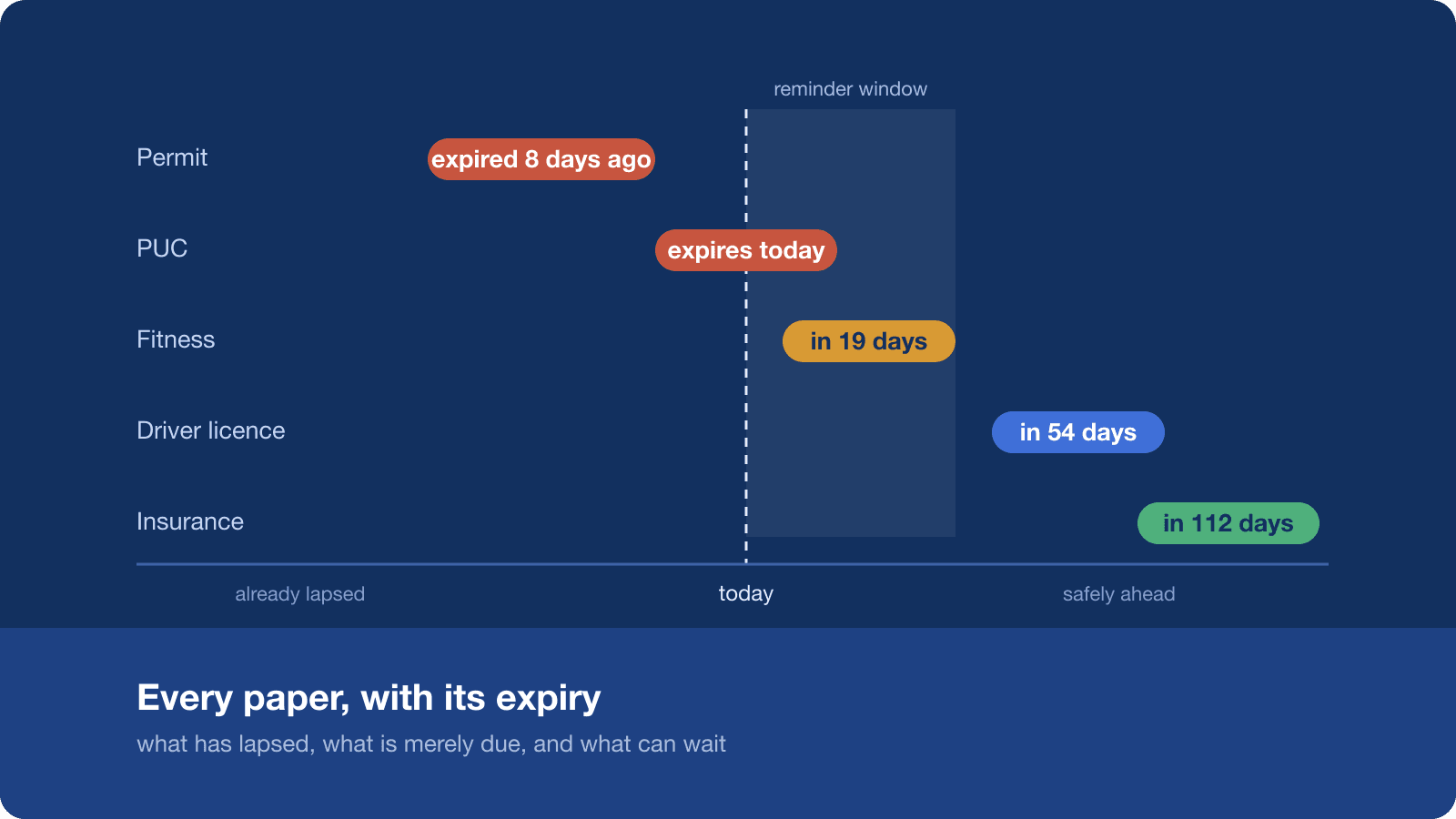
A cab rarely comes off the road because the engine gave up. It comes off the road because a piece of paper expired, and the first person to notice was an officer at a checkpost on the bypass at eleven at night, with a corporate guest sitting in the back.
The vehicle is fine. The driver is fine. The trip still fails, and the client remembers it for a year.
Six documents, six different clocks
A commercial vehicle carries more paper than one person can hold in their head, and no two of those papers renew on the same cycle.
| Document | Typical cycle | Renewed at |
|---|---|---|
| Registration certificate | 15 years, then in blocks of 5 | RTO |
| Fitness certificate | 2 years when new, yearly after that | RTO, with the vehicle present |
| Permit | 5 years, with tax paid quarterly or yearly | State transport department |
| Insurance | Yearly | Insurer |
| PUC | 6 months | Authorised centre |
| Road tax and green tax | Varies by state | State |
Read that as a shape, not as law. The cycles differ by state, by the age of the vehicle and by the kind of permit you hold, and your own RTO is the only authority on your own cab. What does not differ is the shape: several documents, several clocks, none of them aligned, all of them attached to a vehicle that is out earning money two hundred kilometres away.
The fine is the cheapest part of it
An expired permit or fitness certificate carries a penalty you can look up. What it actually costs is everything around the penalty.
The cab stands still for two or three days while the paperwork is fixed, and a cab standing still has a driver drawing salary and an instalment leaving your account on the 5th. The duty it was meant to run goes to the operator down the road, who now has your client's phone number and a reason to use it. If it was a corporate account, the manager who authorised that booking has to explain your cab to somebody in their own office, which is the kind of favour nobody asks for twice.
Insurance is the one that can end a business rather than dent it. A policy that lapsed on the day of an accident means the claim is yours to settle, third-party damages included, and those are not capped by anything you control.
Knowing the date is not the same as having time
The date printed on the certificate is the least useful number in the whole process, because by the time it matters, the work it demands can no longer be done.
Fitness renewal needs the vehicle physically at the RTO. That means a working day when the cab is committed to nothing else, and if it is your busiest vehicle, that day has to be chosen three weeks out rather than found on a Thursday.
Insurance that has already lapsed usually needs an inspection before cover restarts, so the gap between the two policies is a gap you carry uninsured while somebody schedules a surveyor.
A permit renewal or a tax payment can be held up by a clerical mismatch in the RC that nobody knew existed, and discovering it takes a week of its own.
Thirty days of warning is enough to handle all three calmly. Three days of warning turns each of them into somebody's entire morning.
The driver's papers expire too
A licence carries a date, the public service badge required in many states carries its own, and corporate clients increasingly ask for police verification and a photo ID before a driver is allowed into a plant or a campus. A driver carrying an expired licence makes the trip exactly as illegal as an expired permit does, and the insurer will take a close interest in it after an accident. Not all the paperwork sits on the vehicle, so a list that only covers vehicles is only half a list.
What operators who do not get caught actually do
They are not more diligent than everybody else. They have moved the information out of their memory.
One place holds every vehicle and every driver with every date against them. Not a diary rewritten each January, and not a sticker on the windscreen that the last driver peeled off.
Somebody owns the look-ahead. Fifteen minutes on a Monday, reading forward thirty days, starting whatever needs starting.
Renewals are booked as work rather than treated as errands. The cab comes off the duty roster for an RTO visit the same way it would come off for a service.
The proof travels with the cab. A photograph of each document in the driver's phone settles a roadside argument far faster than the original sitting in a file at the office.
Where this sits in TripSetu
Insurance, fitness, permit, PUC and the driver's licence each sit on the record they belong to, with an expiry date the console watches. The reminder window is yours to set rather than a hardcoded thirty days, because a fleet that renews within the city may want fourteen days and an operator whose RTO takes a fortnight may want sixty. The dashboard separates what has lapsed from what is merely due, since those are two different phone calls: one is an apology, the other is only a reminder.
The rest of what the fleet section keeps is on the features page, or bring your own vehicle list to a demo and we will put the dates in with you.
Frequently asked questions
How much warning do I need before a vehicle document expires?
Enough to do the work rather than enough to panic. Fitness needs a day with the vehicle at the RTO, a lapsed insurance policy may need an inspection before cover restarts, and a permit can be held up by a mismatch in the RC. Thirty days covers most of it; if your RTO is slow, set it to sixty.
What does it actually cost when a cab is stopped for expired papers?
The penalty is the part you can look up, and it is usually the smallest part. The real cost is two or three idle days on a vehicle that still owes salary and an instalment, the duty handed to another operator, and the client who watched it happen.
Can I keep vehicle papers in a spreadsheet instead?
Plenty of operators do, and the spreadsheet is not the part that fails. The reading of it is. A list only works if somebody looks thirty days ahead every week, which is why the dates are better kept somewhere the reminder comes to you.