Closing the year when you run cabs: a March checklist
The financial year ends on 31 March whether the cabs are busy or not. What to settle in February and March so April starts clean and your CA is not chasing you.
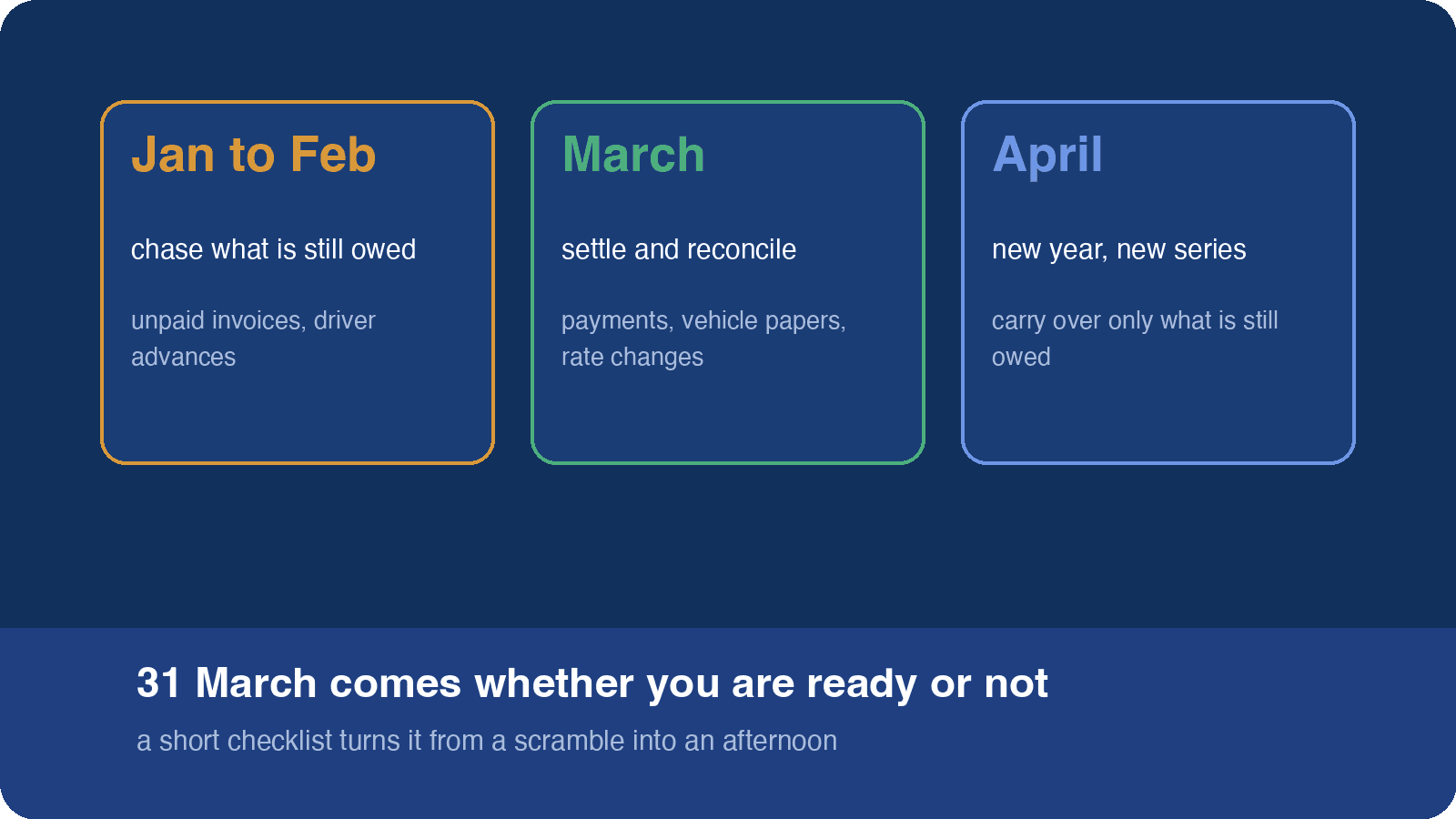
March is the month nobody plans for. The cabs are busy, the corporate clients are rushing their own year end, and then your CA writes to ask for the year. The operators who answer in an afternoon are not more organised by temperament. They have a short list they work through every February.
This is that list, in the order it tends to help. It is general guidance rather than tax advice, and the dates the government sets for returns do move, so confirm them with your CA each year.
Why the date matters more than it seems
The financial year runs from 1 April to 31 March, and everything is measured against it: what you billed, what GST you collected, what you paid out and what profit you made. A trip that ends on 31 March and is invoiced on 2 April is a question your CA will have to answer. Most of the work below is about making sure each rupee lands in the year it belongs to.
January and February: find out what is still owed
Start with receivables, because they are the only part of the year you can still influence. List every issued invoice with nothing or only part received against it, oldest first. For each one, decide whether it is a delay, a dispute or a bad debt. A dispute can usually be fixed while the customer still remembers the trip. A bad debt is better recognised honestly than carried forward as if it will be paid.
Then look at the driver side: advances drawn and not yet adjusted, and any pay that has been promised but not settled. An advance that sits unadjusted across 31 March becomes a balance that someone has to explain in April.
March: settle, reconcile, and fix the dates
Check that every payment you received has been matched to an invoice, and that cash and UPI or bank receipts are recorded separately. Unmatched receipts are the commonest reason a customer's balance in your books differs from theirs.
Look at trips that straddle the year end. A multi-day run that starts on 30 March and ends on 2 April needs a clear rule: which date does the invoice carry, and which year does the revenue belong to? Decide it once, with your CA, and apply it the same way every year.
Vehicle papers deserve a pass as well. Insurance and permits fall due in March and April for many fleets because vehicles were bought or registered in those months. Renew before the date rather than after, since a cab with a lapsed paper earns nothing.
The invoice series
Invoice numbers have to be consecutive and unique within a financial year, and they cannot be longer than sixteen characters. Many operators start a fresh series on 1 April. Others carry one series on. Either is acceptable, as long as you are consistent and no number is skipped or reused inside a year. What you must not do is delete a wrong invoice to tidy the sequence. Cancel it with a reason so it stays accounted for.
If you raise an invoice on 1 April for a trip that happened in March, check which year it should fall in before you issue it. The date on the bill is what puts it in a year.
Changing your rates in April
April is also when many operators revise rates, because fuel and driver costs have moved over twelve months. Do it deliberately: write the new rates against each corporate account, give the customer notice, and note the date from which they apply. A rate change that is decided on the phone and applied inconsistently creates the disputes you worked in February to clear.
What to hand your CA
A list of invoices raised, with the tax on each. A statement of what you received through the year, month by month, with cash and bank apart. What is still outstanding. Your expense bills. If you can produce those four things without a hunt, the conversation in April is short.
Where this sits in TripSetu
Each invoice carries its financial year, and the check that a number has not been used before runs inside that year. The CA statement is a screen that shows receipts by month on the April to March year, with cash and UPI split out, and the outstanding list is the same list you would otherwise build by hand in February.
If you would like to see your own March in it, bring last year's invoices to a demo and we will look at how they lay out.
Frequently asked questions
When does a travel operator's financial year start and end?
For Indian businesses it runs from 1 April to 31 March. Invoices, GST returns and income tax are all measured against that year, so an invoice dated 31 March and one dated 1 April belong to different years even if they are for the same customer.
Do my invoice numbers restart on 1 April?
They may, but they do not have to. What the rules require is that numbers are consecutive and unique within a financial year, and that they stay within the length limit. Many operators restart each April with a year marker in the prefix, which makes the year obvious from the number itself. Pick one approach and keep to it.
What does my CA need from me at year end?
A list of invoices raised with their tax, what was received and how, split between cash and bank, what is still outstanding, and your expenses with bills. Producing this month by month through the year is far cheaper than assembling it from a year of paper in the last week of March.