Travel agency outstanding payments: the 45-day trap
Corporate clients pay in 30 to 45 days. Drivers and fuel are paid weekly. That gap, not your margin, is what closes small travel businesses.
Ask an operator running twelve cabs how the business is doing and you will usually get an answer about margin. Ask how much is owed to the business today, by whom, and how long it has been owed, and the answer takes a phone call, a diary and about twenty minutes.
That second number is the one that closes travel businesses. Not margin: margin is usually fine. It is the gap between when money goes out and when it comes in.
The gap nobody budgets for
Look at what a week actually costs you. Diesel or CNG is drawn on a khata at the pump and settled monthly, but the pump owner expects it. Driver salary goes out on a fixed date. Batta and food for an outstation run are handed over before the cab leaves. A tyre or a clutch plate does not wait for a corporate approval cycle.
Now look at when the money arrives. A corporate client with a proper accounts department pays in 30 to 45 days from the invoice date, and that clock only starts when the invoice reaches the right desk with the right purchase order number on it. Send it on the 3rd with a detail missing and you may not see the money until the second week of the month after next.
So you are funding sixty days of somebody else's operations out of your own pocket, every month, while running a business on weekly cash. That is the trap. It has nothing to do with whether the trips were profitable.
Profit and cash are not the same number
Here is the shape of it for a small fleet in a steady month. The figures are illustrative, but the pattern will look familiar.
| Item | Amount |
|---|---|
| Billed this month | 4,80,000 |
| Actually received this month | 3,10,000 |
| Paid out this month | 3,65,000 |
| Profit on paper | Healthy |
| Cash position | Short by 55,000 |
Every line of that is consistent. The month was profitable and you still could not pay everyone. Repeat it twice and you are borrowing against a business that is doing well, which is a strange and demoralising place to be.
The register does not show you this, because a register records what happened on a trip. It has no column for what has not happened yet.
Aging is the number that matters, not the total
"Two lakh outstanding" tells you almost nothing. Two lakh spread across four clients who all pay on day 40 is a working business. Two lakh sitting with one client at day 95 is a problem you should already be in a meeting about.
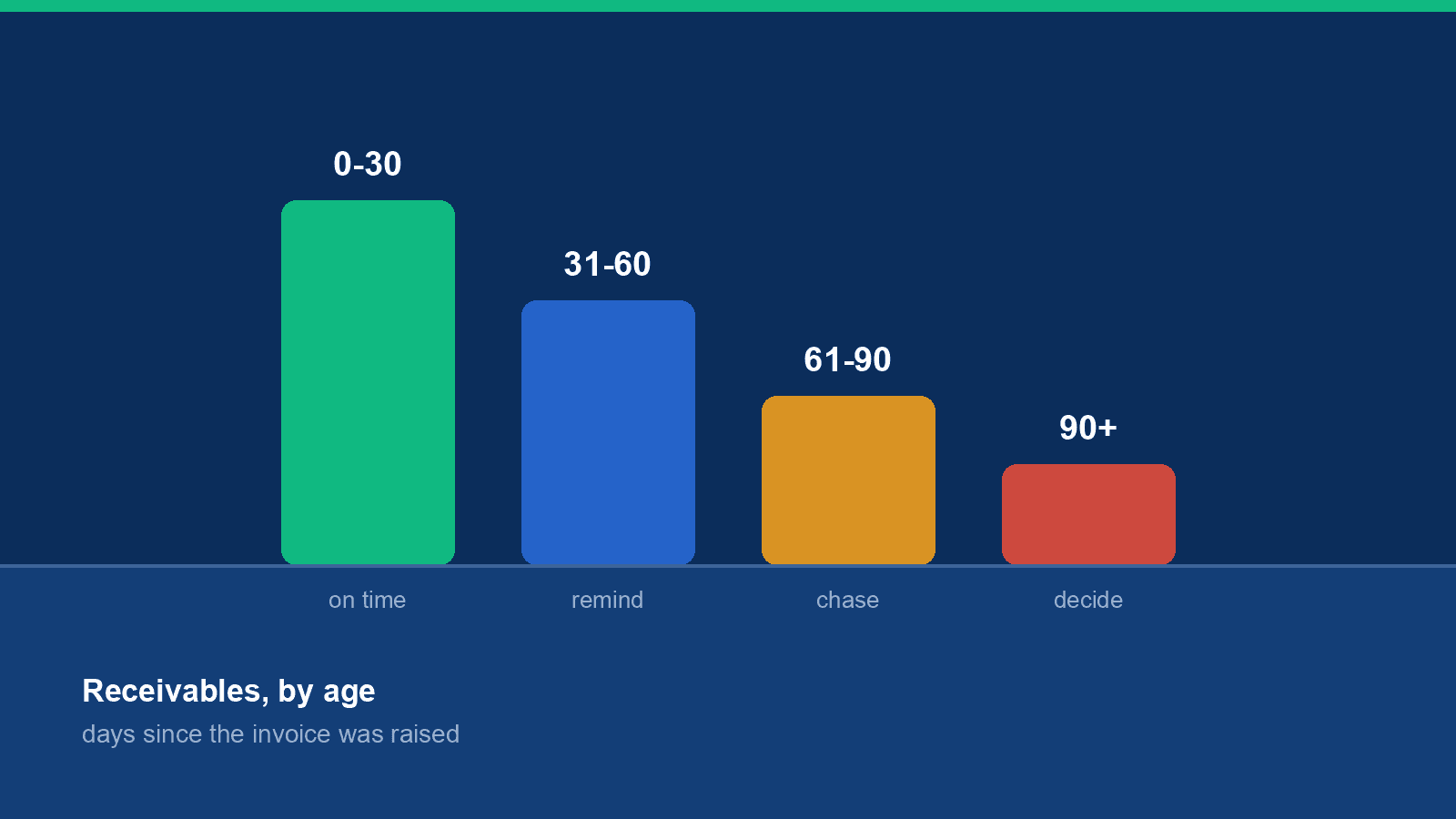
That is why the useful view is not a total but a set of buckets: what is 0 to 30 days old, 31 to 60, 61 to 90, and over 90. Each bucket asks a different question of you:
0 to 30 is normal. Leave it alone.
31 to 60 is the polite-reminder window, and a reminder sent here works far better than one sent later, because the invoice is still recent enough for the person receiving it to place it without searching.
61 to 90 means something went wrong in the process rather than with the client. Usually the invoice never reached the right person, or it was rejected quietly for a missing PO number and nobody told you.
Over 90 is a decision, not a follow-up. Either you escalate to somebody senior, or you stop giving that client credit, or you accept you may not see it.
Sorting the same money into those four columns changes what you do on a Monday morning. It is the difference between chasing everybody a little and chasing the right person properly.
What actually gets an invoice paid
Most delays are not the client refusing to pay. They are process failures on our side, and they are dull and fixable.
Raise the invoice the day the trip closes, not at month end. A month-end batch means your 2nd-of-the-month trip waits four weeks before the payment clock even starts.
Carry the reference the client needs. A PO number, a cost centre, an employee name, whatever their accounts team matches against. An invoice they cannot match is an invoice that sits in a tray.
Send a statement, not a chase. A single list showing every open invoice, its date and its age is easier for a finance person to act on than four separate messages asking about four bills, and it is much easier to forward internally.
Know who actually pays. The manager who books the cab is rarely the person who releases the money. Getting that second name early saves a fortnight later.
Set a credit limit before you need one
Every operator has had the client who books steadily, pays slowly, and one day is at two months of unpaid work, and by then saying no is a real business decision, not an administrative one.
A credit limit is just deciding that number in advance, when you are calm. It does not have to block anything. In TripSetu it warns rather than refuses, because a dispatcher at seven in the morning should never be stopped from recording a booking by a billing rule. But the warning arrives at the moment the exposure is being created, which is the only moment it is any use.
Start with the aging list
If you do one thing this week, build the list: every unpaid invoice, who owes it, and how many days old it is. It takes an afternoon by hand the first time and it usually produces at least one surprise: an invoice from March that everyone assumed had been settled.
Keeping it current by hand is the part that fails, which is the reason receivables aging is a screen in TripSetu rather than a report you ask for. The console builds those four buckets from invoices and payments you have already recorded, so the list is accurate on the morning you need it. You can see the rest of what it tracks on the features page, or bring last month's register to a demo and we will put your own numbers through it with you.
Frequently asked questions
What are receivables aging buckets?
The same outstanding money sorted by how long it has been owed, usually 0-30 days, 31-60, 61-90 and over 90. A total tells you how much is owed; the buckets tell you which invoices need a reminder, which need chasing, and which have become a decision about whether to keep extending credit.
How long do corporate clients take to pay a travel operator?
Typically 30 to 45 days from the invoice date, and the clock only starts once the invoice reaches the right desk with the reference their accounts team needs, such as a purchase order number. A missing detail can push payment into the following month without anyone telling you.
Should a credit limit block new bookings?
No. A dispatcher taking a call at seven in the morning should never be stopped by a billing rule. The useful behaviour is a warning at the moment the exposure is created, leaving the decision with the owner rather than the software.