The rate card is the contract
A rate agreed on a phone call is a rate you will argue about. Packages, extra kilometres, night charges and cancellations, written down once per account.
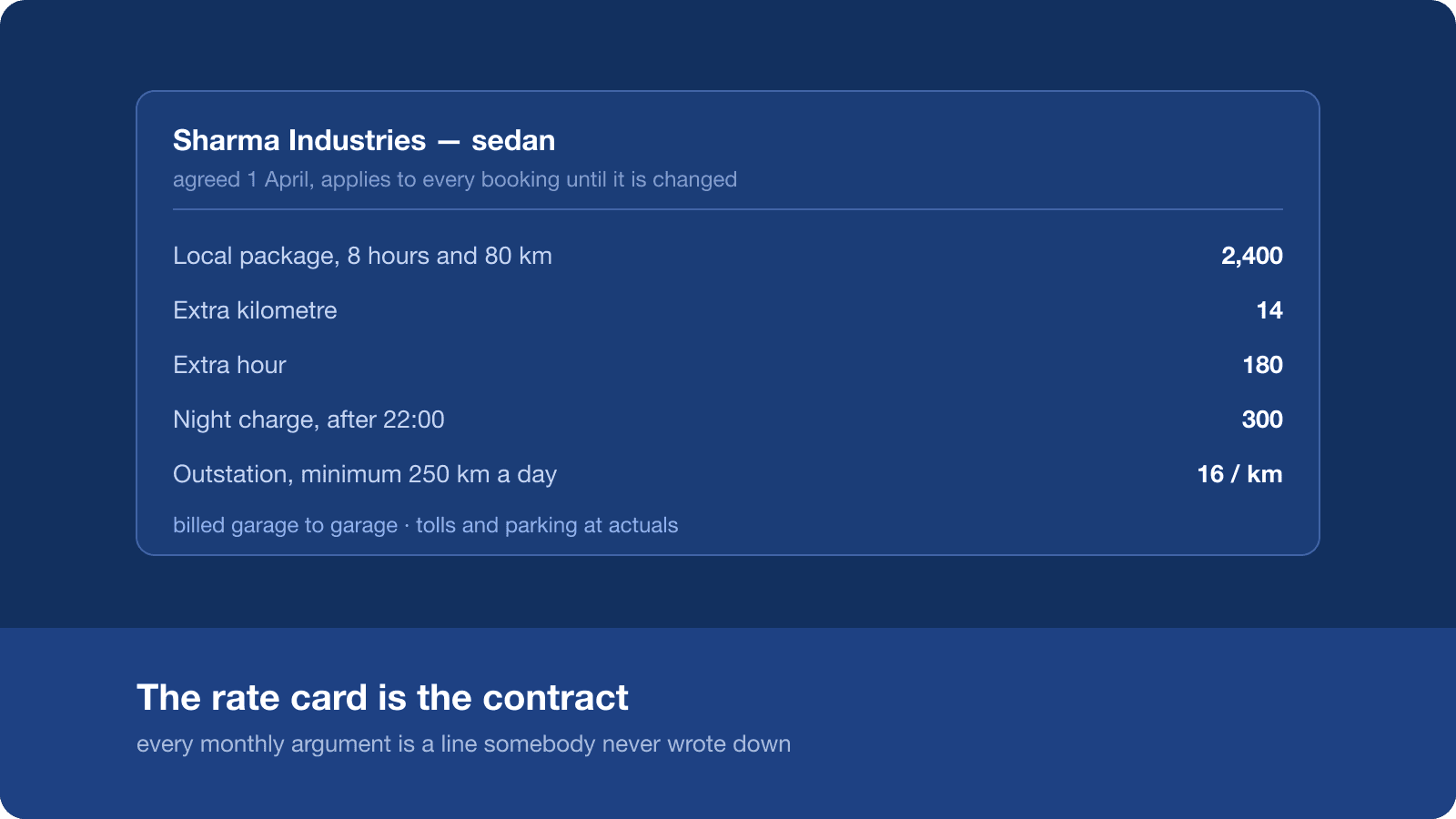
Take any argument you have had with a client at month end and trace it back. It will end at a line nobody wrote down: what happens after the eighth hour, whether the minimum applies on the day the cab did only ninety kilometres, whether the night charge starts at ten or at eleven.
The rate was agreed. The rate card was not.
A rate is not a number
A number is what you say on the phone to win the work. A rate card is the set of rules that decides what the bill says, and it has seven or eight lines in it whether you write them or not.
| Line | What it settles |
|---|---|
| Local package | the block of hours and kilometres included |
| Extra kilometre | what happens beyond the package |
| Extra hour | the part that gets forgotten until it appears |
| Night charge | and the hour it starts |
| Outstation per kilometre | with the daily minimum |
| Driver allowance | whether batta is billed separately or built in |
| Tolls and parking | at actuals, or included |
| Cancellation and no-show | the cab that left the yard at five |
You do not need every line for every client. You need the lines you actually use to be the same in your head, on the quotation and on the invoice.
The package, and what it hides
Eight hours and eighty kilometres is the most common local package in the trade, and it is a fair deal for both sides on a normal day. It goes wrong on the day the guest keeps the cab until nine at night, because two clocks ran past their limit at once and the bill now carries extra hours and extra kilometres, which to a client reads as two charges for the same delay.
Explaining that on the 31st is a bad conversation. Having it on the rate card, in one line each, is not a conversation at all.
The outstation minimum is fair and it is always disputed
A daily minimum, commonly two hundred and fifty kilometres, exists because a cab on a three-day tour is unavailable for three days whether it runs eight hundred kilometres or two hundred. The client sees a bill for seven hundred and fifty kilometres against a trip that did four hundred and calls it padding.
It is not padding, and the way to make that obvious is to state the minimum in the quotation the account signs, not to justify it after the fact. Where a client refuses the minimum, price the day instead. Either is workable; the ambiguity is not.
Freeze the rate onto the trip
Rates are revised. Fuel moves, a contract renews, a client negotiates. The damage comes from a revision applying backwards, when a rate changed in October quietly rewrites the September trips that have not yet been billed.
The rule worth holding is simple: the rate that applies to a trip is the rate that was agreed when the trip was booked, and it travels with the trip until it is paid. A revision applies to what comes next.
One rate card per customer, not one per phone call
If the rate lives in the memory of whoever took the booking, then two people quoting the same corporate account will eventually quote differently, and the client will notice before you do. The account's rate belongs to the account, written once, applied automatically, visible to everybody who can take a booking.
This is also how you find out that the client you think is your best one has been on a rate agreed three years ago.
Cancellations, and the cab that already left
A trip cancelled the night before costs you an empty slot. A trip cancelled at half past five, with the driver at the gate, costs you fuel, a driver's day and the booking you turned away. Most clients accept a cancellation line when it is on the rate card and almost none accept it when it appears for the first time on a bill.
Where this sits in TripSetu
Each customer carries their own rate card, and it is applied to the booking automatically and frozen onto the trip, so a rate change next quarter does not rewrite last quarter's billing, and two people taking bookings quote the same number. The booking carries the rate it was agreed at, the trip sheet carries what happened, and the invoice is built from both.
The rest of what the directory holds is on the features page, or bring your three biggest accounts' rates to a demo and we will set them up with you.
Frequently asked questions
What should a cab rate card contain?
The local package in hours and kilometres, the extra kilometre and extra hour rates, the night charge and the hour it starts, the outstation rate with its daily minimum, how the driver allowance is handled, whether tolls and parking are at actuals, and a cancellation line.
What does an 8 hour 80 km package mean?
A block of time and distance included in one price for a local duty. Beyond either limit the extra hour and extra kilometre rates apply, which is why a guest keeping the cab late can produce two extra charges for what feels like one delay.
How should a mid-year rate revision be handled?
Apply it forward only. The rate that governs a trip should be the one agreed when the trip was booked, carried with the trip until it is paid, so an October revision cannot rewrite September's unbilled duties.