Owned, attached, or somebody else’s cab
The third vehicle rarely has to be bought. Attaching a cab costs margin and buys the ability to say yes, and the choice is made per vehicle, not once.
The client asks whether you can put four cabs on from Monday. You have two. Somewhere in the next twenty minutes you will decide whether to buy a vehicle, attach one, or ring the operator across town. Most of the time that decision gets made on instinct and lived with for three years.
Three ways to put a cab on a duty
You can own it, which means an instalment, insurance, permit, a driver on your payroll and every rupee of the margin. You can attach it, where an owner-driver runs his own vehicle under your name on terms you agree. Or you can sub-contract the duty outright to another operator for the day.
All three are normal. Operators who only do the first grow slowly and sleep badly in a lean month. Operators who only do the third are brokers, and the client eventually works that out.
The arithmetic of one duty
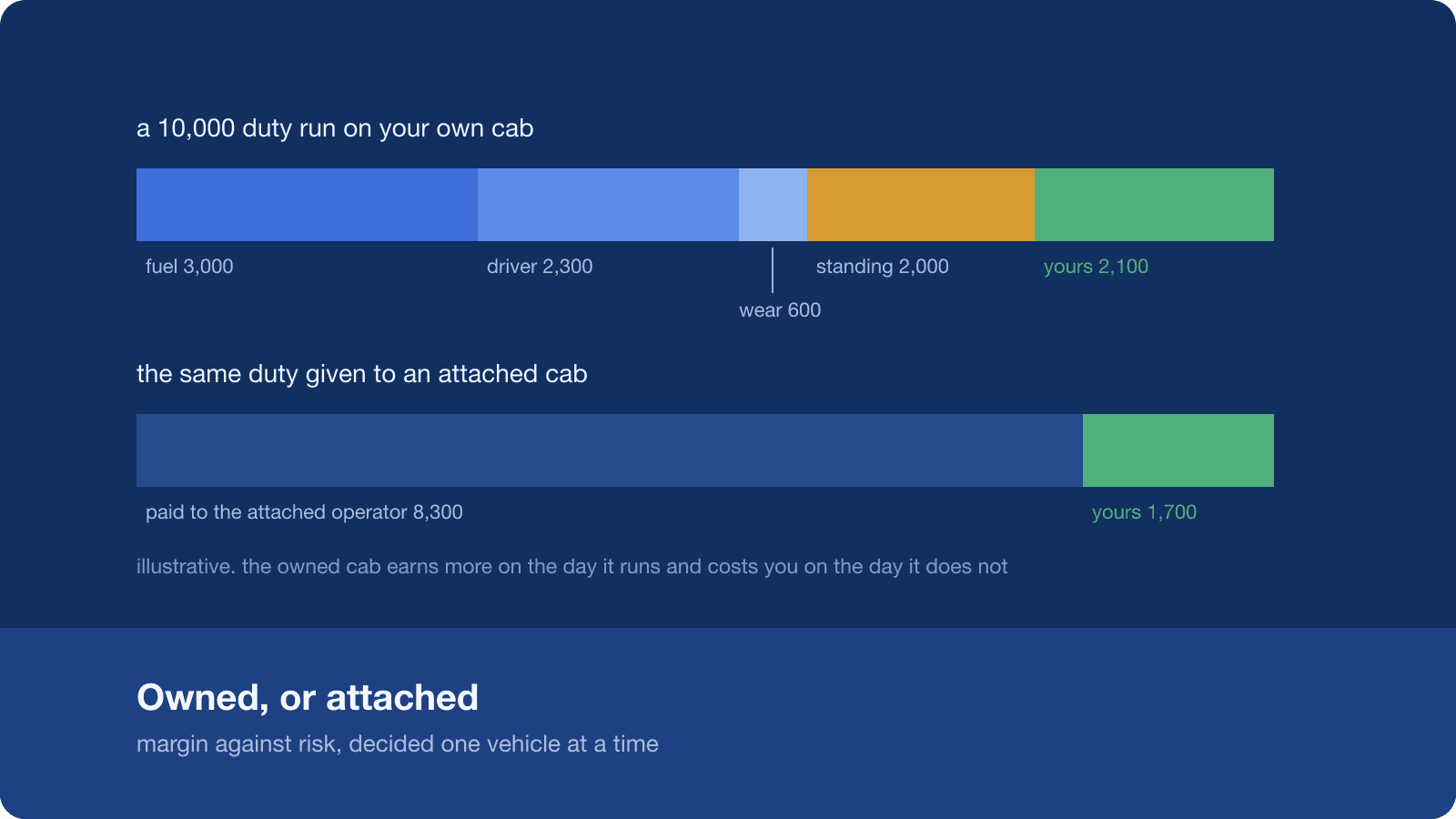
On a ten thousand rupee duty run on your own cab, a rough shape might be three thousand of fuel, twenty-three hundred of driver pay, six hundred of wear and two thousand of standing costs, leaving about twenty-one hundred. Give the same duty to an attached cab at eighty-three hundred and you keep seventeen hundred.
Four hundred rupees is what the flexibility costs on a good day. The comparison changes completely on the day the duty does not exist: the owned cab still costs you its standing share, and the attached cab costs you nothing at all.
| Owned | Attached | |
|---|---|---|
| Margin on a duty | higher | lower |
| Cost on an idle day | full standing cost | none |
| Control of vehicle and driver | yours | borrowed |
| Cash needed to start | an instalment | none |
That is the real trade. Not margin against margin, but margin against the risk of a quiet fortnight.
What you are actually buying when you attach
The ability to say yes. A small operator's reputation is built almost entirely on answering yes in the twenty minutes when a client has a problem, and attached capacity is what lets you do that without a loan.
It also lets you test demand before committing. If a new corporate account needs a third sedan every Tuesday and Thursday, run it attached for a quarter. If it holds, buy. If the account changes its travel policy in month two, you have lost nothing but a little margin.
What you give away, and how to give away less
Margin, obviously. But the two that hurt are control of the vehicle's condition and control of the driver's behaviour, because the guest in the back does not know whose cab it is. Yours is the only name he has.
So the attached cab is not somebody else's problem. Keep a copy of its insurance, permit, fitness and the driver's licence, with their expiry dates, exactly as you would for your own, because when a client's security desk asks, or when something happens on the highway, the paperwork is produced by you and the reputation on the line is yours.
Agree the rate and the settlement cycle in writing before the first duty, not after the first dispute. And handle the client yourself: the moment an attached owner is taking instructions directly from your customer, you have introduced him to your customer.
Attaching moves the problem, it does not remove it
Attached owners expect settlement weekly or fortnightly, because they too have fuel and an instalment. Your corporate client pays in forty-five days. Every duty you sub-contract widens the gap between money going out and money coming in, which is a different problem from the one you solved.
That is manageable, but only if you are watching it. Growth built on attached cabs and corporate credit is growth that consumes cash even while every duty is profitable.
When it is genuinely time to buy
When a vehicle has a base load you can predict for a year, not a busy quarter. When attached supply in your season is unreliable, so the yes you gave is at somebody else's mercy. And when the per-vehicle numbers on the cabs you already own say they are earning, not when the loan is merely available.
Where this sits in TripSetu
Vehicles are recorded as owned, attached or leased, and the papers and their expiry dates are kept the same way for all three. The operators you sub-contract to sit in the directory beside your customers, so a duty given away is still a duty with a record. And the per-vehicle profit and loss works on an attached cab as well as an owned one, which is how you find out whether the four hundred rupees was worth it.
The rest of what the fleet and directory sections cover is on the features page, or bring last month's sub-contracted duties to a demo and we will cost them out with you.
Frequently asked questions
Is it better to own cabs or attach them?
Owned earns more per duty and costs you on the day it stands. Attached earns less and costs nothing when idle. The honest answer is per vehicle and per season rather than a policy for the whole fleet.
Who looks after an attached vehicle's papers?
The owner holds them, but you are the name the client sees, so keep copies with their expiry dates and check them the way you check your own. A security desk turning a cab away does not ask whose vehicle it is.
How should a sub-contracted duty be priced?
Work back from what the duty earns you rather than forward from what the other operator asks. Agree the rate and the settlement cycle in writing before the first trip, and remember that you will pay him long before the client pays you.