GST for a small travel operator, in plain language
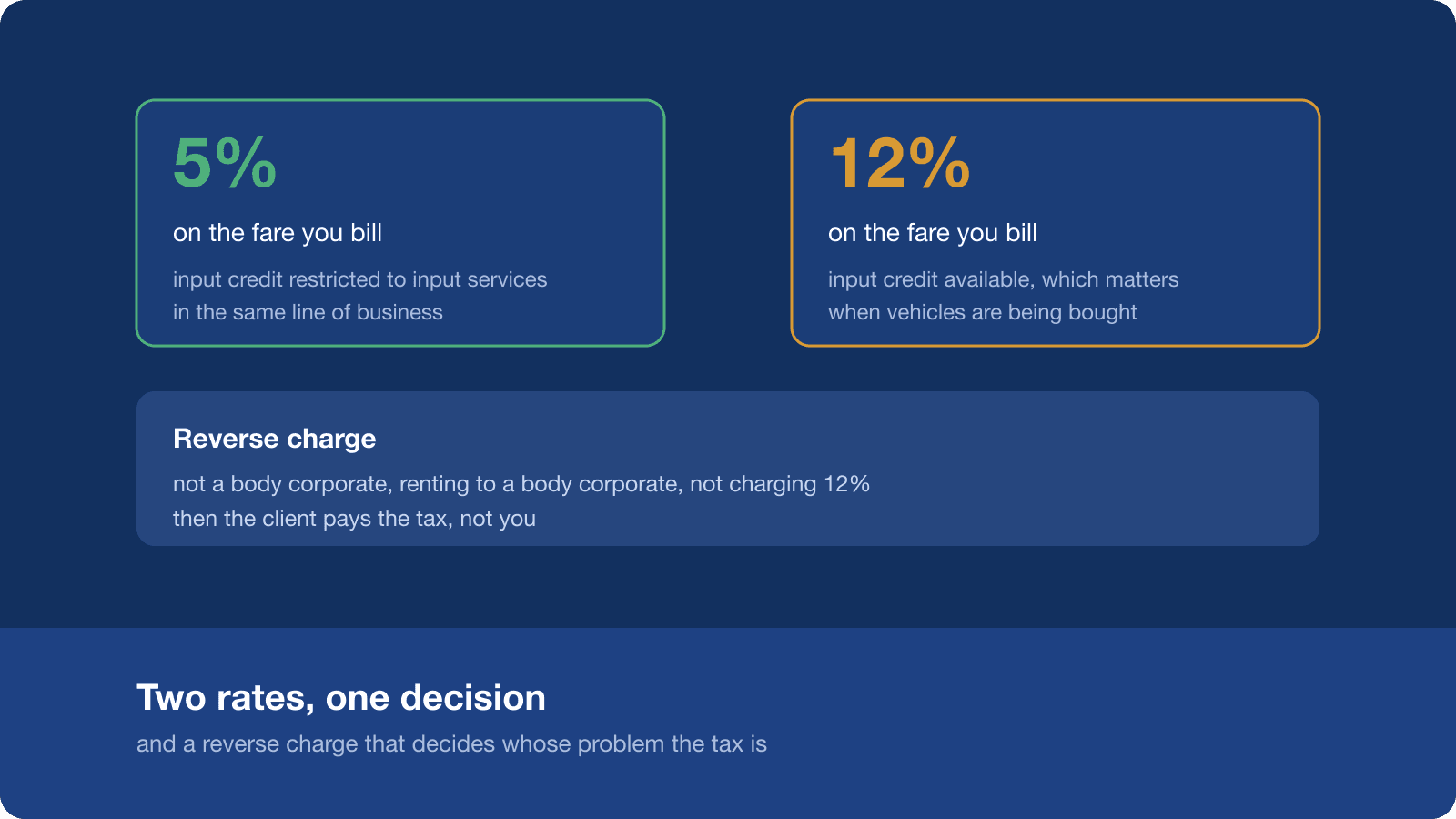
Five per cent without input credit or twelve with it, and the reverse charge that makes a corporate client pay the tax instead of you. The shape of the decision.
Most operators meet GST twice. Once when a corporate client asks for a GST invoice before releasing a payment, and once when the CA asks a question in March that can only be answered by going through a year of paper.
What follows is how the trade talks about it, not tax advice. The notifications have been amended several times and your own case depends on your turnover, your constitution and who your customers are, so treat this as the shape of the decision and let your CA confirm it for your business.
The choice you make once: five or twelve
For renting a vehicle with a driver, two rates are commonly used, and they are a package rather than a preference.
At 5 per cent, the fare is cheaper for the client, and your input credit is restricted. Broadly, credit on input services in the same line of business, not on the vehicle itself. At 12 per cent, credit is available, which starts to matter when you are buying vehicles, paying large service bills or taking cabs from other operators who charge you tax.
| 5 per cent | 12 per cent | |
|---|---|---|
| Effect on the client's price | lower | higher |
| Input credit | restricted | available |
| Suits | steady fleet, few purchases | expanding fleet, heavy sub-contracting |
Operators who are buying a vehicle a year and sub-contracting regularly are usually the ones who do the arithmetic and find twelve works out better. The rest generally stay at five because the price on the quotation wins the work.
The reverse charge that surprises people
This is the one that causes the phone call. Where the supplier is not a body corporate, rents a passenger vehicle to a body corporate, and does not charge the higher rate, the tax is payable by the recipient under reverse charge rather than by you.
In practice this means a corporate client may tell you not to add GST to the bill, and they are not trying to save money at your expense. Under that entry it is their liability, not yours. It also means the invoice has to say so on its face, because their accounts team needs the line to process it, and a missing line is the sort of thing that parks a bill in a tray for a fortnight.
The distinction that matters is what you are and what they are. A proprietorship or partnership billing a company is not the same case as a private limited billing the same company.
The invoice has to carry more than a number
A bill a corporate accounts team can pay without coming back to you carries your GSTIN, theirs, the place of supply, the rate applied, and where relevant a line saying tax is payable under reverse charge. It also carries whatever reference their system matches against, which is usually a purchase order number.
None of that is difficult. All of it is the difference between a payment cycle that starts this week and one that starts next month.
Outstation runs and place of supply
A trip from Lucknow to Delhi raises a question a local run never does: which state's tax applies. For passenger transport the place of supply generally turns on where the passenger embarks, and where the recipient is registered, on the recipient's location. It is worth getting your CA to write down the rule once, for the two or three patterns you actually run, rather than deciding it invoice by invoice.
What the CA actually needs in April
Not a shoebox. A month-by-month statement of what came in and how, with cash and bank separated, sitting on the April to March year, and a list of bills raised with their tax. Operators who can produce that in ten minutes pay less for their accounting and spend less of March explaining things.
Where this sits in TripSetu
Invoices go out under your own letterhead, your GSTIN and your bank details, frozen onto the bill as it was sent, so a copy reprinted next year still shows what the customer holds. If you are not registered, the tax columns switch off entirely. And the statement the CA asks for (cash and UPI split by month, on the April to March year) is a screen rather than an evening's work.
The rest of what the money section covers is on the features page, or bring last quarter's invoices to a demo and we will look at how they are laid out.
Frequently asked questions
Should a cab operator charge 5 per cent or 12 per cent GST?
They are a package rather than a preference. Five keeps the client's price lower but restricts input credit; twelve allows credit, which tends to win when you are buying vehicles or sub-contracting heavily. Work it out with your CA on your own numbers, because it is not a decision you want to revisit every quarter.
What is reverse charge on cab hire to a company?
Where the supplier is not a body corporate, rents a passenger vehicle to a body corporate and does not charge the higher rate, the recipient pays the tax rather than the supplier. The invoice should say so on its face, or the client's accounts team will hold it.
Does a small travel business need GST registration?
It depends on aggregate turnover against the threshold in force, on your state, and on whether anything else in your business triggers registration. Corporate clients often expect a GSTIN regardless, which in practice decides it for many operators before the threshold does.