The duty slip decides what you can bill
A trip is billed from what the duty slip says, not from what happened. Readings, tolls and a signature separate a bill that gets paid from one that gets argued.
Nobody argues about the rate. The rate was agreed months ago, it is on the mail, and both sides know it. The argument is always about the kilometres, the hours, and a toll receipt somebody cannot find.
All three of those are decided by a piece of paper the size of a postcard, filled in by a driver at the end of a twelve-hour day, in a car park, in the dark. Whatever it says is what you get to charge. Whatever it leaves out, you pay for yourself.
Four numbers carry the whole bill
Nearly everything a corporate bill contains is calculated from four readings: the odometer when the cab left, the odometer when it came back, the time out and the time in.
| Line on the slip | Reading |
|---|---|
| Odometer out | 48,210 |
| Odometer in | 48,486 |
| Distance | 276 km |
| Out | 07:10 |
| In | 19:40 |
| Duty | 12 h 30 m |
| Tolls paid | 460 |
| Parking | 80 |
Extra kilometres beyond the package, extra hours beyond the eight, the night charge, the outstation minimum of 250 km a day, all of it falls out of those four numbers. Which is why a slip with the closing reading left blank is not a minor omission. It is an unbillable trip that you will settle by guessing, and you will guess low, because the client is on the phone and you would rather keep the account.
Decide garage to garage or pickup to drop once, in writing
This single line causes more monthly disputes than anything else on a travel bill. If your rate card bills from garage to garage, say so on the rate card, on the quotation and on the invoice, because a client who assumed the clock started at their gate will read the extra 18 km as padding.
Neither convention is wrong. Both are normal in the trade. The damage comes from never having written it down, so the conversation has to happen every month, with a different person in the accounts team each time.
Tolls and parking leak quietly
The driver pays the toll in cash because there is no other way to get through the plaza. The receipt goes into a shirt pocket, through a wash, and the 460 rupees becomes yours. Nobody stole it. It simply never reached the invoice.
Over a fleet of ten cabs running outstation work, small cash spends that never get billed are one of the largest and least visible costs in the business, and they are invisible precisely because each one is trivial.
A photograph of the slip and the receipts, taken at drop, before the driver goes home, fixes most of it. The picture does not have to be neat. It only has to exist before the paper does not.
A signature turns a claim into evidence
An unsigned duty slip is your word about what happened. A signed one is the client's own record of it, and when the accounts team queries 276 km against a rate card that expected 240, the signature of the guest who sat in the cab ends the discussion in one mail rather than four.
Get the name printed under the signature too. Six weeks later, an illegible scrawl and a mobile number nobody recognises is not much better than nothing.
Month end is where kilometres die
If slips are collected and billed once a month, the trip from the 2nd is reconstructed on the 31st from a driver's memory and a diary written in a hurry. The waiting hours get rounded down. The night halt is forgotten. The toll is missing. And because the invoice goes out four weeks late, the 45-day payment clock starts four weeks late as well.
Closing a trip the day it ends is not an accounting preference. It is the difference between billing what happened and billing what everyone can still remember.
Where this sits in TripSetu
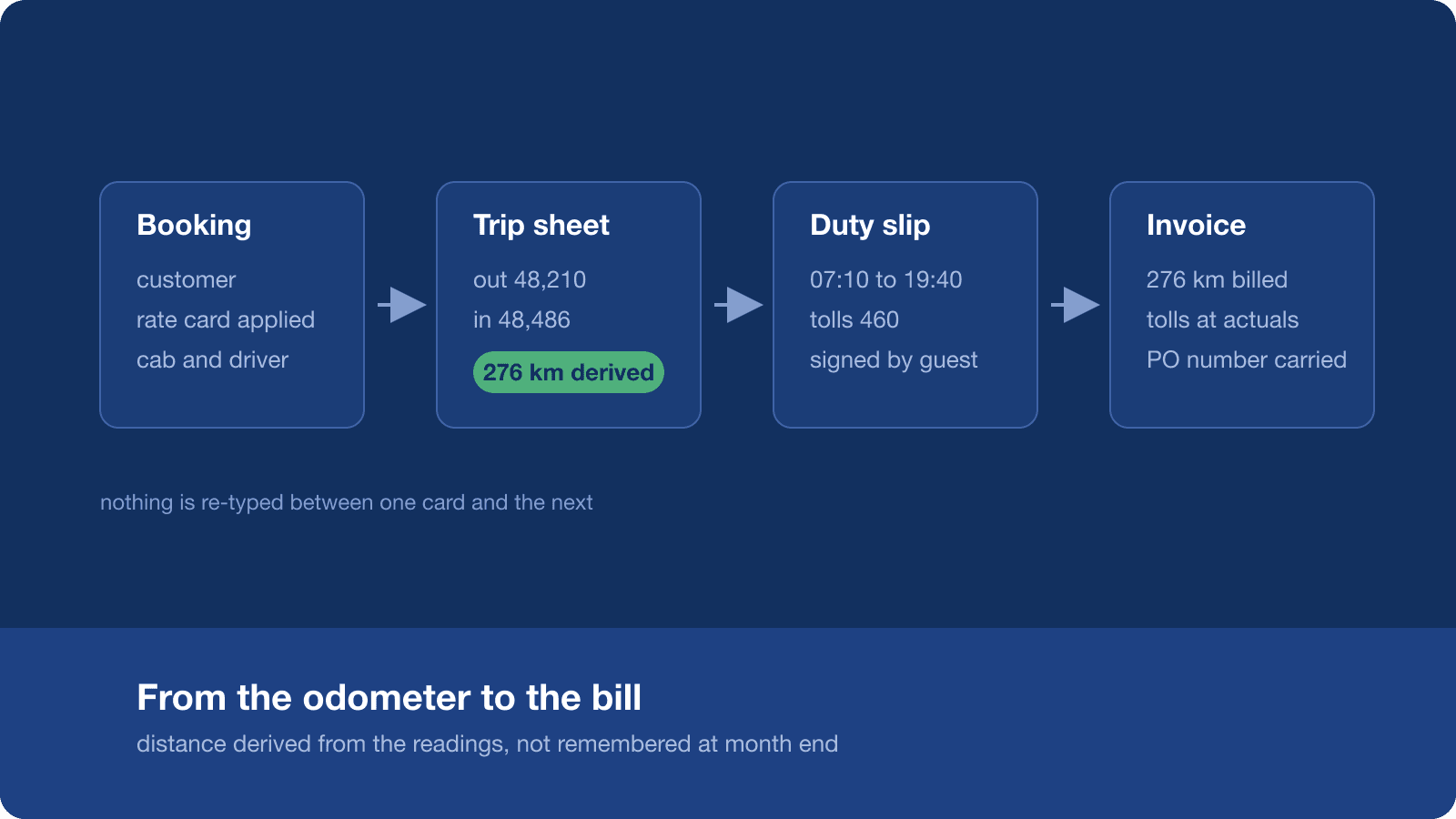
A trip sheet in TripSetu carries the start and close odometer readings, the fuel filled, and tolls and parking as they were paid. Distance is derived from the readings rather than typed, so the number on the bill is the number that was on the dial. The rate comes from the customer's rate card and is frozen onto the trip, which means a revision next quarter does not quietly rewrite what you billed last quarter. When the trip closes, the invoice is built from it rather than re-keyed from a diary.
The rest of what the trip sheet holds is on the features page, and a demo works best if you bring last month's duty slips and we run a few of them through it together.
Frequently asked questions
Should a taxi bill be garage to garage or pickup to drop?
Both are normal in the trade, and the choice matters far less than writing it down. Put the basis on the rate card, the quotation and the invoice. Disputes come from the assumption never being stated, not from the convention itself.
What should a duty slip carry, at a minimum?
Odometer out and in, time out and in, tolls and parking paid in cash, and a signature with the guest's name printed under it. Everything else on a corporate bill is calculated from those.
Why not collect all the slips and bill at month end?
Because the trip from the 2nd gets reconstructed on the 31st from memory, and memory rounds in the client's favour. It also delays the invoice by up to four weeks, and the payment clock only starts when the invoice is raised.