A month of driver pay should be a figure, not an argument
Salary, night charge, batta and the advances already drawn. Most driver pay disputes are not about the amount but about who wrote it down at the time.
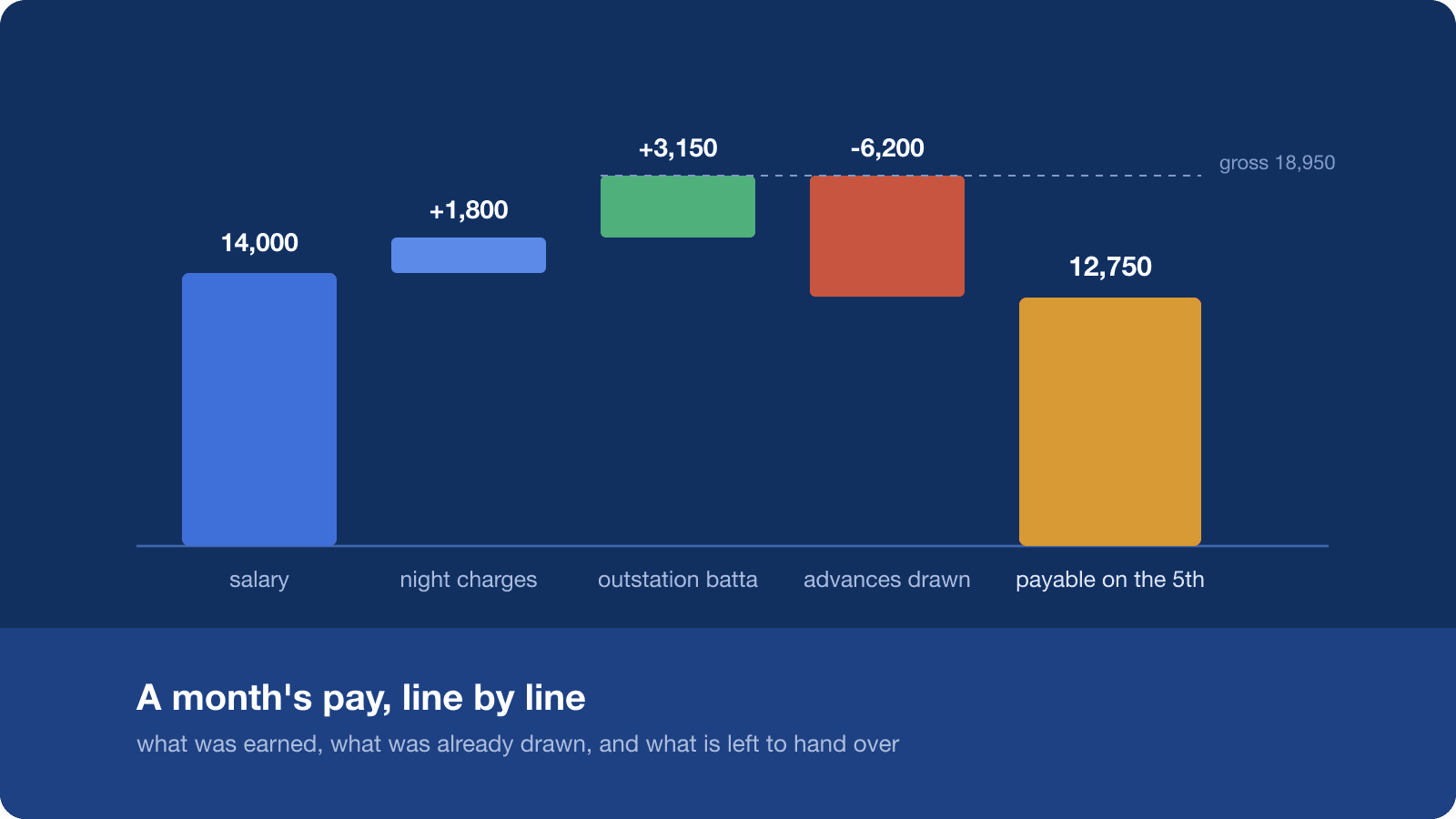
Pay day in a small fleet is rarely a payment. It is a negotiation, conducted standing up, near the gate, between two people who both believe they are right and neither of whom wrote anything down.
The driver remembers four advances. You remember six. He is certain about the night halt in Kanpur. You are certain you already paid for it. Nobody is lying. The month simply happened faster than either of you recorded it.
A driver's pay is never one number
Even in a fleet of six cabs, what a driver earns is assembled from parts that arrive at different times and in different ways.
There is the base, whether that is a monthly salary or a per-trip rate. There is the night charge for a duty that runs past a certain hour. There is batta, the daily allowance for an outstation run, usually handed over in cash before the cab leaves. There may be an incentive on collections or on kilometres. And running against all of it are the advances: money drawn mid-month for a wedding, a school fee, a tyre bought from the driver's own pocket on the highway at midnight.
| Line | Amount |
|---|---|
| Base salary | 14,000 |
| Night charges, 6 duties | 1,800 |
| Outstation batta, 9 days | 3,150 |
| Gross for the month | 18,950 |
| Less advances drawn | 6,200 |
| Payable on the 5th | 12,750 |
Six lines. Any one of them can be disputed if only one of the two people involved kept a record of it.
Batta is the line that causes the trouble
Batta is money the driver spends to stay alive away from home: food, a bed, a wash. It is handed over in cash, before the trip, often in a hurry, and it is the single most commonly unrecorded number in the business.
The arrangement itself varies and there is no correct version. Some operators pay a flat daily allowance and expect nothing back. Some reimburse against bills. Some advance a lump sum for a four-day tour and settle the balance on return. All three are workable. What is not workable is having never said which one applies, because then every long trip ends with a conversation about what was owed, and the conversation is had at the end, when both sides are tired.
Write the basis down once, when the driver joins. A daily rate for outstation, whether it changes for a night halt, and whether it is settled with the month or with the trip. Two lines, agreed in a calm moment, replace a year of arguments.
Record the advance while the cash is still in your hand
Every unrecorded advance was recorded once, in somebody's memory, at the moment it was handed over. The failure is never the giving. It is the twenty seconds afterwards.
A note on a phone, sent to the driver, works better than a diary in a drawer, because it does two things at once: it records the amount and it tells him you recorded it. Half the disputes at month end are not about the money but about the discovery. The driver who finds out on the 5th that he owes 6,200 has been spending a month's pay he thought he had.
Keep reimbursements apart from advances
When a driver pays for a puncture or a toll out of his own pocket, that is your expense, not his loan. Mixing the two into one running figure is how a driver ends up believing the company eats his money, and once he believes that, he stops paying for anything on the road and a stranded cab waits three hours for someone to send cash.
Two columns. Money he owes the business. Money the business owes him. They are not the same column with a sign in front of it, even though the arithmetic comes out the same, because the trust does not.
The test of a working system
A driver should be able to ask, on any day of the month, how much he has drawn and how much is left, and get the answer before he finishes asking. That is the whole standard. Everything else, the neatness of the register, the software, the format, only matters to the extent that it produces that answer in under a minute.
Fleets that can do this lose fewer drivers, and losing a driver in this trade costs more than anything on the payslip: a cab standing idle while you look, a new man who does not know the client's gate pass, and a corporate account wondering why a different face turns up every quarter.
Where this sits in TripSetu
A driver record carries the pay basis, salary or per-trip, along with the night charge and the day's allowance, and the advances already drawn are held against the same record. So a month's pay is a figure the console produces rather than a conversation two people have from memory. It is a small screen, and it removes one of the more corrosive arguments in a small fleet.
You can see what else sits under fleet on the features page, or bring last month's advance register to a demo and we will reconcile one driver with you.
Frequently asked questions
What is batta for a cab driver?
The daily allowance for an outstation duty, covering food, a bed and a wash away from home. It is usually handed over in cash before the cab leaves, which is exactly why it is the number most often missing from the month's reckoning.
Should batta be adjusted against salary?
Either way works, as long as it was agreed at the start. Some operators pay a flat daily rate with nothing to settle, some reimburse against bills, some advance a lump sum and settle on return. The damage comes from the basis never being stated, not from the choice.
How should driver advances be tracked?
At the moment the cash leaves your hand, not at month end. Record the amount and tell the driver you have recorded it, and keep what he owes the business separate from what the business owes him for money he spent on the road.