One cab, two duties, and a call at six in the morning
Bookings arrive by call, WhatsApp, mail and walk-in, and end up in four places. The clash is created on Tuesday and discovered at dawn on Thursday.
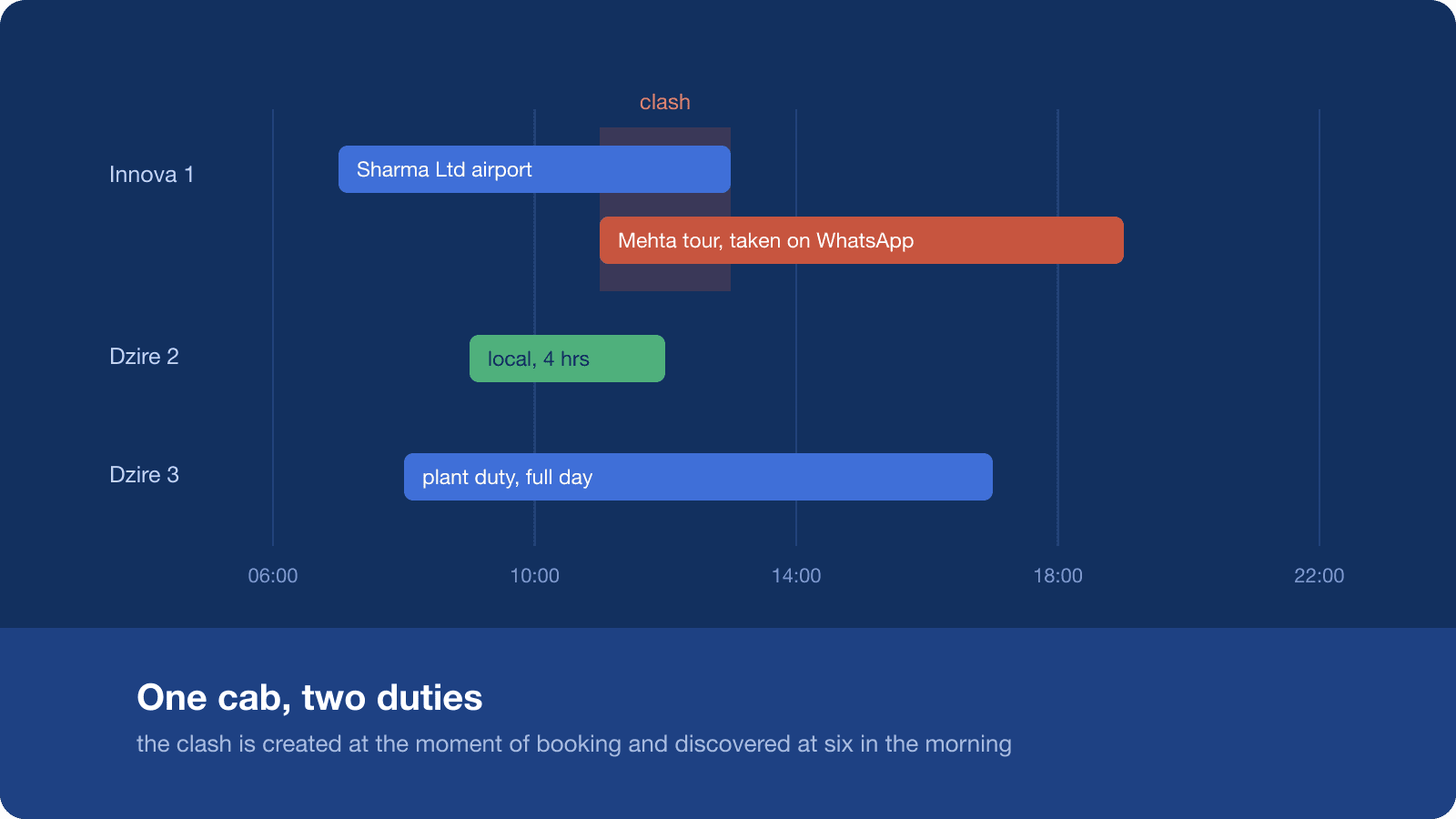
The call comes at ten past six. The driver is at the client's gate, the guest is in the car, and your brother-in-law is on the other line asking why the Innova is not at the hotel for the Mehta family tour, which he confirmed on Tuesday.
Both bookings are real. Both were promised. One of them is now a phone call you have to make to somebody who trusted you.
Bookings arrive on five channels and land in four places
A call to the office landline. A WhatsApp message to your personal number at ten at night. A mail from the corporate client with a cc to somebody who has left the company. A walk-in at the counter. And the one nobody counts, the regular passenger who rings the driver directly because the driver gave him his number last month.
None of those channels is wrong. Each of them is how a real customer prefers to work with you, and telling a client to use a different one is how you lose the client. The problem is not the channels. It is that they end in four different places: a diary, two phones and somebody's memory.
A diary works until two people write in it
One person with one diary rarely double-books, because the check and the record live in the same head at the same moment. Add one more person who can commit a cab, and the arithmetic changes completely: now every booking needs the other person's page to be current before it can be safely taken, and it never is.
This is the point at which most operators feel they have outgrown paper. It is usually the second or third vehicle, not the tenth.
What a booking has to carry to be a booking
A name and a time is not a booking. It is an intention, and it will be argued about later.
| Field | Why it is on the list |
|---|---|
| Customer | who is billed, which is often not who travels |
| Passenger | who the driver is looking for at the gate |
| Date and time, from and to | what actually blocks the cab |
| Vehicle and driver | the part that can clash |
| Rate agreed | so nobody reconstructs it at billing |
| Pickup and drop | what the driver needs at five in the morning |
The customer and the passenger being separate fields matters more than it looks. A corporate account books eleven trips a month for nine different employees, and if the passenger's name lives only in a WhatsApp thread, then the day a bill is queried you are searching chat history instead of a record.
The clash has to be refused at the moment it is created
A double booking is not discovered at six in the morning. It is created on Tuesday afternoon, by somebody who had no way of knowing, and it then sits there quietly for three days.
That is why the check belongs at the moment of entry rather than in a review the night before. If the cab is already committed for that window, the person taking the booking needs to know while the customer is still on the line, because right then they have three good options, and at six in the morning they have none.
On the line, you can offer the other vehicle, offer a different time, or say honestly that you cannot do it. At dawn you can only sub-contract at whatever rate the other operator names, or apologise to a client who has a flight.
The one discipline that has to hold
The booking is recorded when it is taken, not when you get back to the office. Every double booking in the trade traces back to a gap between agreeing to something and writing it down, and the gap is usually under an hour.
It does not matter much what it is recorded into, as long as it is the only place. Two systems, even two good ones, is the same as none.
Where this sits in TripSetu
Bookings sit on one calendar, with local runs, outstation duties and multi-day tours on the same view, and the clash check refuses a cab that is already out. A booking carries the customer, the passenger and the rate it was agreed at, so the trip sheet and the invoice are built from it rather than from memory. A multi-day tour blocks the vehicle for its whole span, which is the case a diary handles worst.
The rest of what the booking screen holds is on the features page, or bring a week of your own bookings to a demo and we will put them on the calendar with you.
Frequently asked questions
How do I stop double bookings in a small fleet?
Record the booking at the moment it is taken, in one place that everybody who can commit a cab uses, and check the vehicle's availability at that same moment. Double bookings are created when a promise and the record of it are separated by an hour.
Should tentative enquiries be recorded as bookings?
Record them, but mark them as tentative rather than confirmed, and give them an expiry. An enquiry nobody wrote down is the one that gets promised twice, and a tentative held open for ever is a cab you cannot sell.
Why keep the customer and the passenger as separate fields?
Because the company that pays the bill is usually not the person sitting in the cab. Keeping them apart is what lets you answer a billing query about one employee's trip without searching a chat thread.