What one kilometre actually costs you
Fuel is the cost everyone quotes from. Driver pay, tyres, insurance and the instalment decide whether a rate of fifteen a kilometre is profit or a slow loss.
A client asks for a rate. You do the sum everyone does: fuel is around seven rupees a kilometre, so at fifteen there is room. You quote fifteen, you win the account, and eight months later the account is busy, the cabs are running, and there is no money.
The arithmetic was not wrong. It was incomplete. Fuel is the cost you can see from the driver's seat, and it is rarely more than half of what a kilometre actually costs you.
Four buckets, not one
Everything a vehicle costs falls into four groups, and they behave completely differently.
Running costs move with every kilometre: diesel, CNG, petrol. Person costs are the driver, his batta and his night charges. Wear costs are tyres, servicing, brake pads, a clutch plate, the gearbox job that arrives without warning at 180,000 km. Standing costs are what the vehicle costs simply by existing this month: insurance, permit and tax, the loan instalment, parking, the office that raises the bills.
| Bucket | Per kilometre |
|---|---|
| Fuel | 7.20 |
| Driver pay and batta | 4.30 |
| Tyres, service, repairs | 1.50 |
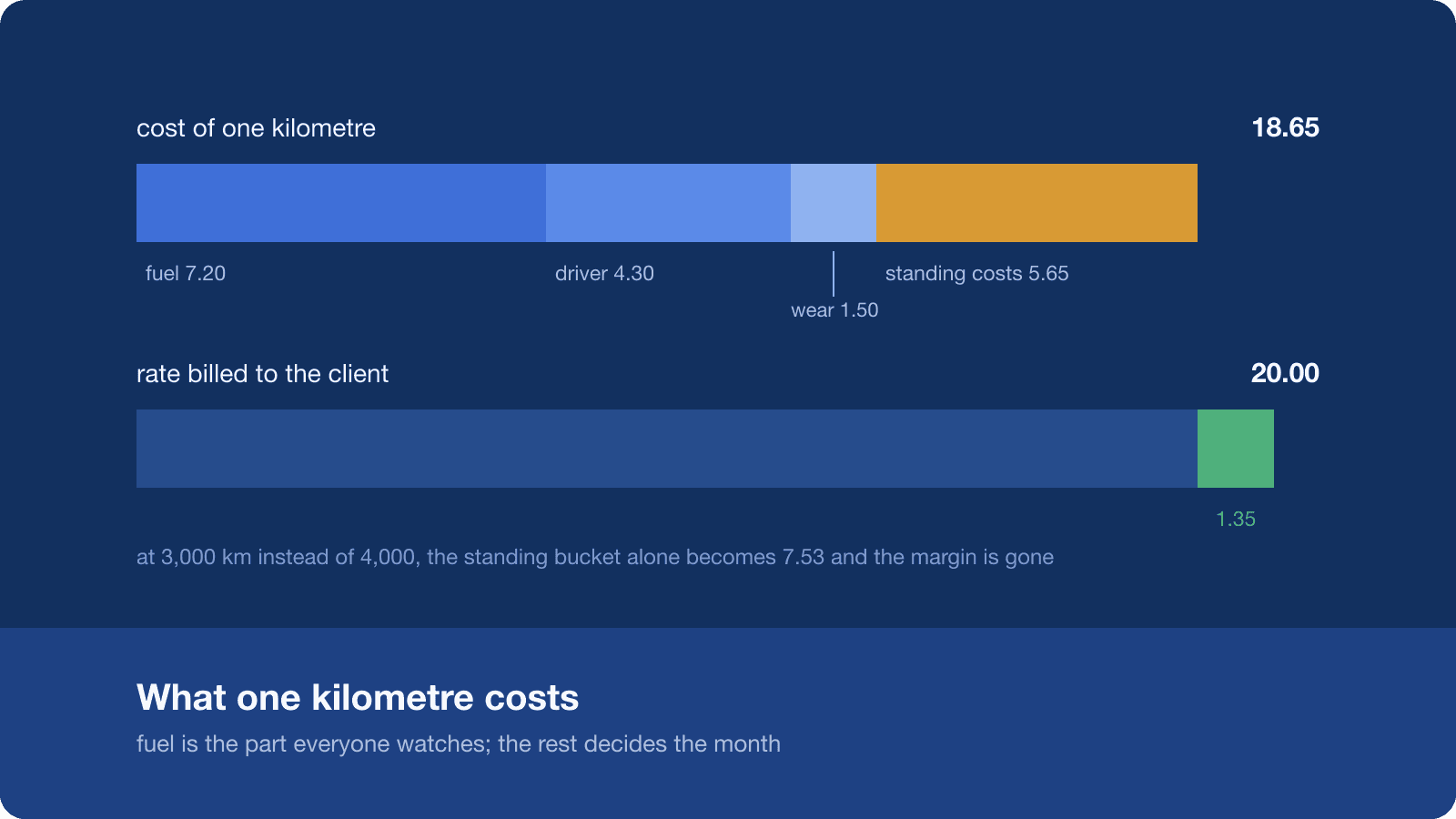
| Standing costs, spread over 4,000 km | 5.65 |
| Cost per kilometre | 18.65 |
Those figures are illustrative. Your fuel price, your driver's pay and your instalment are all different. The shape is what transfers: the thing everybody quotes from is under half the total, and the bucket almost nobody quotes from is the second largest.
Utilisation decides your cost, not your rate card
Look again at that last bucket. Standing costs are a monthly figure divided by the kilometres you actually ran. Nothing about them changes when the cab stays in the yard, so every kilometre you do not run makes every kilometre you do run more expensive.
Run the same vehicle 3,000 km instead of 4,000 and the standing bucket alone goes from 5.65 to 7.53. The cost per kilometre crosses twenty, and the rate you were comfortable with last quarter is now losing money, without one thing on the rate card having changed.
This is why an empty return leg matters more than a fuel price rise, and why three days lost to a fitness renewal is not an administrative inconvenience. It is why the second vehicle bought in a hurry, to serve one demanding client, so often makes the whole fleet worse: it adds a full set of standing costs and only a part-time set of kilometres.
The fleet average hides the vehicle that is losing money
An average over eight cabs is a comfortable number and it is nearly useless. It contains the two-year-old sedan on a steady corporate contract and the eight-year-old people carrier that spent nine days in the workshop, and it quietly funds the second with the first.
The number worth having is per vehicle, over a period you choose. Once you can see it, three decisions get easier and one gets uncomfortable: which cab to put on the next contract, which one to sell before the next major job, whether to attach a vehicle rather than buy one, and whether the cab you are fondest of has been carried by the rest of the fleet for a year.
Where the numbers come from
You do not need an accountant for this. You need four things you are already recording, kept against the vehicle rather than in a pile.
Fuel comes off the trip sheets, which is the reason for writing the fuel filled next to the odometer readings rather than in a separate pump book. Driver pay comes from what you settle each month. Maintenance has to be logged against the cab it was spent on, at the time, because a tyre bill in a folder marked Expenses helps nobody. Standing costs sit in the file already: the insurance premium, the tax receipt, the loan schedule. They only need dividing.
Do it for one vehicle for one quarter and the method is yours for good.
What the number is for
Not for a report. For three conversations.
The first is quoting, where knowing the floor lets you hold a rate without guessing and lets you walk away from work that cannot pay, which is a skill most operators acquire expensively and late.
The second is renewal, when a client asks for last year's rate and you can answer with what changed rather than with a feeling.
The third is replacement, where the question is never whether the old cab still runs, but whether the kilometre it produces costs more than the kilometre a newer one would.
Where this sits in TripSetu
TripSetu keeps a per-vehicle profit and loss: earnings against fuel, driver pay, maintenance and expenses, for one cab, over any period you choose. Maintenance is logged against the vehicle it was spent on, which is what makes the number mean anything. The screen states its method on its face, so you can argue with the number instead of guessing at it.
The rest of what the money section covers is on the features page, or bring one vehicle's last quarter to a demo and we will work its cost per kilometre out with you.
Frequently asked questions
How do I calculate cost per kilometre for a taxi?
Add four buckets over a fixed period for one vehicle: fuel, driver pay and batta, wear items such as tyres and servicing, and standing costs like insurance, permit, tax and the instalment. Divide the total by the kilometres actually run in that period.
Why does my cost per kilometre change when nothing else has?
Because standing costs are a monthly figure divided by kilometres run. Fewer kilometres in a month spreads the same insurance, tax and instalment over less distance, so idle days raise the cost of every kilometre you did run.
Should I look at cost per kilometre for the whole fleet or per vehicle?
Per vehicle. A fleet average blends the cab on a steady contract with the one that spent nine days in the workshop, and it will keep the second one invisible for as long as the first one covers it.