Fixing an invoice after it has gone out
A wrong date, a missing toll, a customer who wants the day-wise breakup. What a small operator can change on an issued invoice, and when it takes a credit note.
Every operator has the same Tuesday. An invoice went out on Friday, and on Tuesday the customer calls. The date is wrong, a toll was left off, the accounts team wants the hire split day by day, or it was raised against the wrong office. The bill is out and the question is what you are allowed to do about it.
What follows is how the trade handles it, not tax advice. The rules depend on your registration and on what has happened to the invoice since it left, so let your CA confirm the final step for your business.
Why you cannot just change the number on it
An issued invoice is not a draft with a different font. The customer has a copy, their accounts team may have booked it, and if you are registered it may already sit inside a return. Quietly overwriting a figure means the two copies disagree, and the disagreement surfaces months later, usually in an audit, usually when the person who made the change is not in the room.
There is a second reason. Invoice numbers have to run in a consecutive series, and each number has to be unique within the financial year. Deleting a wrong invoice to start again leaves a hole in the series. Raising a second invoice for the same job gives the customer two numbers for one trip. Both are harder to explain than the original mistake.
Three honest routes
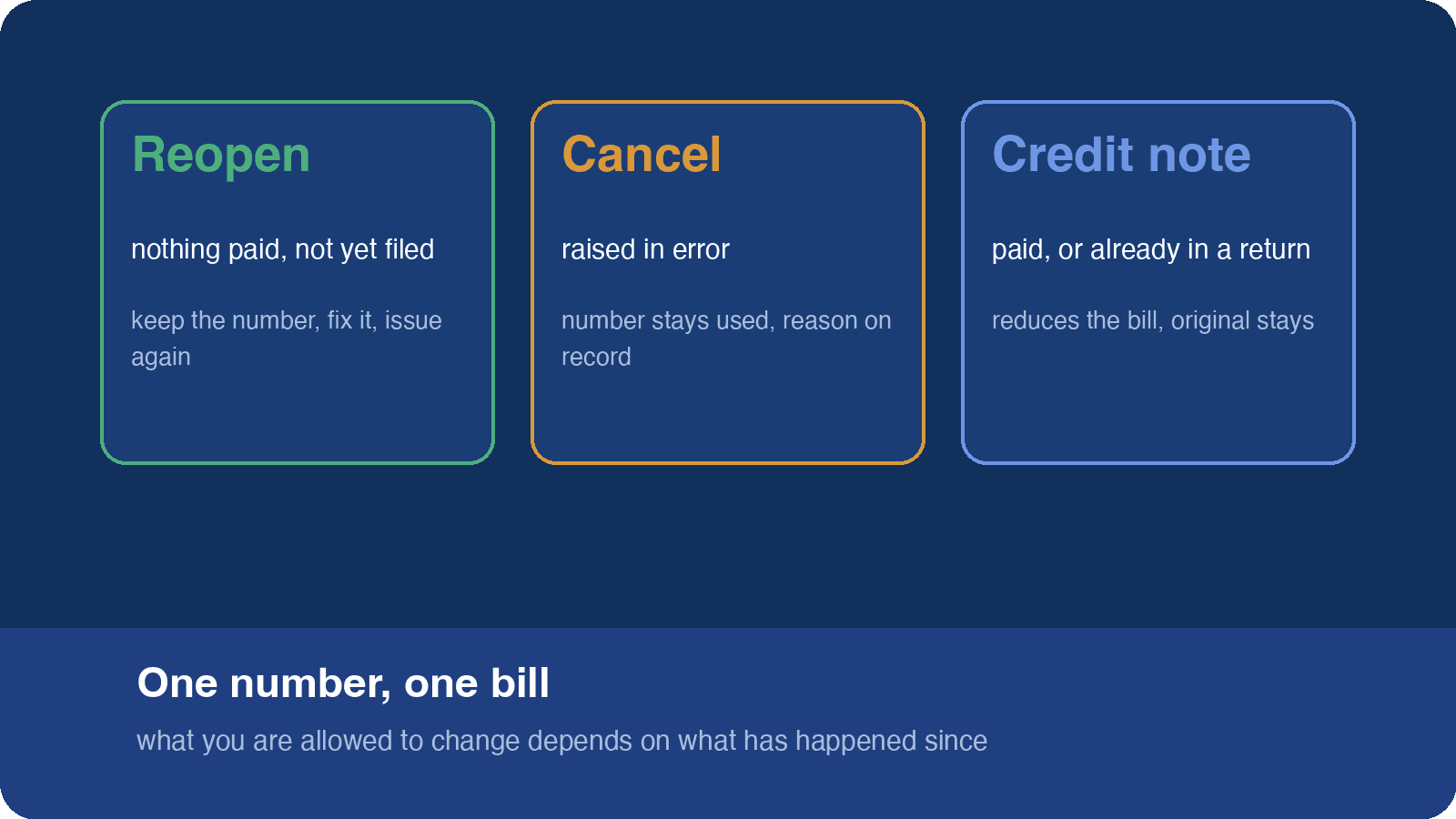
In practice there are three things you can do, and which one is right depends on two questions: has any money been received against it, and has it been reported anywhere yet.
| When it fits | What happens to the number | |
|---|---|---|
| Reopen and issue again | Nothing paid, not yet in a filed return, customer waiting for a corrected copy | Same number, same place in the series |
| Cancel | Raised in error, against the wrong party, or the trip never happened | Number stays used, marked cancelled, reason recorded |
| Credit note | Money received, or the invoice is already in a return | Original stays; the note reduces it, and a fresh invoice follows if needed |
Reopen and issue again
This is the right answer for most Tuesday phone calls. The invoice goes back to a draft, you fix the line that was wrong, and you issue it again under the same number. The customer ends up with one number for one job. The thing to be disciplined about is the reason: write down why it was reopened, because a change to an issued bill with no explanation is exactly what an auditor circles.
Tell the customer as well. The copy they already hold stays as it was until the corrected one reaches them, and an accounts team that has already booked the first copy needs to know a second is coming.
Cancel, with a reason
If the invoice should never have existed, cancel it. Keep the number, mark it cancelled and record why. If a correct invoice is needed afterwards, it takes the next number in the series. The cancelled one stays in the register as a fact: it was raised, and it was withdrawn.
Two limits apply. You cannot cancel an invoice that has money against it without first dealing with that payment, because the money has to go somewhere. And if you are on e-invoicing, cancelling has its own short window on the government portal, so ask your CA before you assume it is a button on your side only.
When it has to be a credit note
Once a customer has paid, or the invoice has gone into a return you have filed, it is a settled fact between several parties. Reopening it would rewrite something other people are relying on. The tool for this is a credit note: a document that refers to the original invoice and reduces what it charged. The original is left alone, the note sits beside it, and if the customer still owes something, a fresh invoice follows.
The GST law sets a time limit for issuing these and says in which month's return they are reported, so this is the one step where you should not improvise.
A small habit that prevents most of this
Most corrections are not tax questions. They are a toll that was never entered, a PO number the customer needed, or a date that was typed from memory. A short look at the draft before it is issued, against the duty slip and the booking, removes the majority of the Tuesday calls. The number is only used once the invoice is issued, so the draft is the cheap place to be wrong.
Where this sits in TripSetu
An invoice is a draft until you issue it, and only then does it take a number. After that it is closed to edits. An admin can reopen an issued invoice that has nothing paid on it, with a reason, and it keeps its number until it is issued again. Cancelling needs a reason too, and the number stays used. Anything with money against it is held back, so a settled invoice is not rewritten by accident.
If you want to see how a reopened invoice behaves with your own numbering, bring a recent invoice to a demo and we will walk through it.
Frequently asked questions
Can I edit an invoice after I have issued it?
Not silently. An issued tax invoice is a record the customer holds and, once you have filed, the tax authority does too. If nothing has been paid and the customer is waiting for a corrected copy, reopening it and issuing it again under the same number is the cleanest route. If money has moved or the invoice is in a filed return, the usual answer is a credit note and a fresh invoice. Your CA can tell you which applies.
Will cancelling an invoice leave a gap in my invoice numbers?
It should not. A cancelled invoice keeps its number and is marked cancelled with a reason, so the series stays unbroken. A missing number is the thing an auditor asks about, which is why deleting an issued invoice is the wrong fix.
What is a credit note?
A document you raise to reduce what an earlier invoice charged, for example when a fare was overstated or a trip was cancelled after billing. It refers to the original invoice, which stays on the books. The rules on when and how to issue one are set in the GST law, so confirm the details with your CA.