Fuel, tolls and parking: who pays for what on a trip
The quote says fifteen a kilometre and nothing else. Then the tolls, a parking fee and a diesel bill land on you. How to write the quote so the extras are recovered.
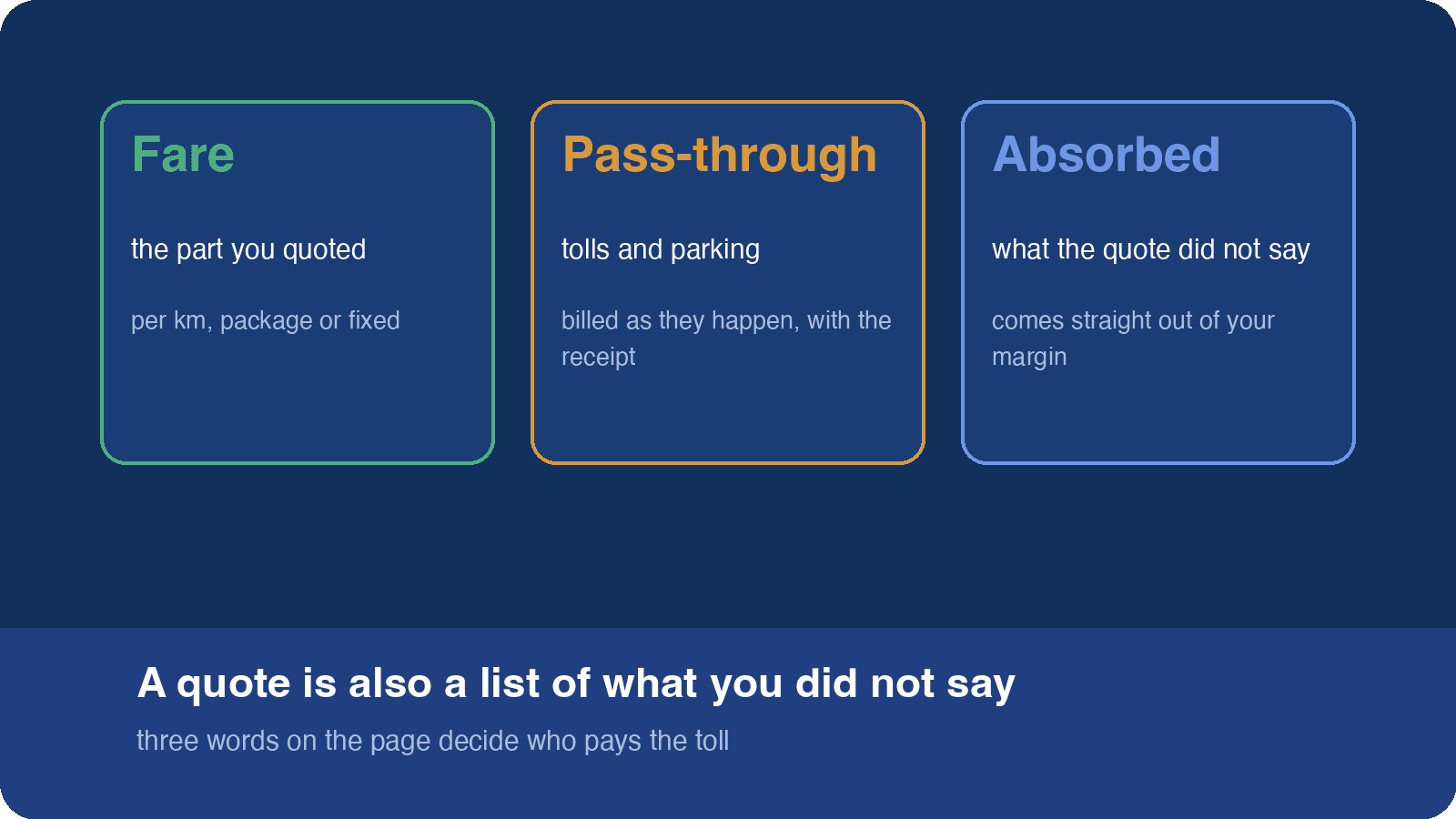
A customer asks for a cab to the airport and back, and you say fifteen a kilometre. It is a clear number, it sounds fair, and it quietly leaves out the toll on the way out, the parking at the terminal and the state entry fee on the way back. Nobody lied. Nobody said anything. And by the end of the month the trips that went wrong are the ones where the extras were never mentioned.
This post is about the three or four sentences that should sit under the fare on every quote. The figures below are examples for illustration, not rates to copy.
Two kinds of cost, and they behave differently
The first kind is the cost of running the cab, which you carry anyway: fuel, the driver, wear, insurance. These are inside your per-kilometre rate, and the cost per kilometre post on this blog covers how to work out what they come to. The customer does not pay for them separately, and does not expect to.
The second kind is costs that depend on the specific trip and are paid to a third party: tolls, parking, state entry or border fees, and sometimes a driver's night halt arranged on the road. These vary by route and by day, they are small individually, and they are exactly what an operator forgets to recover.
Three ways to quote them
| Quote style | Who carries the risk | Where it goes wrong |
|---|---|---|
| Fare only, extras silent | You | Every unrecovered toll comes out of margin |
| Fare plus tolls and parking at actuals | The customer | Needs a receipt for each item, or the customer queries it |
| One all-inclusive price | You | A dearer route than you assumed is your loss |
None of these is wrong. The second is the most common for corporate accounts because it is fair to both sides, and the third suits a customer who wants one number and is happy for you to take the route risk. The first is the one to avoid, because it is not a decision: it is an omission that looks like one.
A worked example
Take a 300 kilometre outstation run billed at fourteen a kilometre. The fare is 4,200 rupees. Suppose the route has 480 rupees of tolls and 100 of parking, and the quote said nothing about either. The customer, quite reasonably, thinks the price is 4,200. You have spent 580 of it on the road.
If your margin on that run was 20 per cent, you earned about 840 rupees. The unrecovered 580 takes it to 260. One quiet clause, tolls and parking at actuals, turns the same trip back into 840.
Fuel is a different question
On a per-kilometre rate, fuel is already inside the number, so it is not a line on the bill. Where it is separate is a daily or package rate with fuel at actuals, which some corporate accounts prefer. In that case agree how it will be measured: from the odometer readings and a stated mileage, or from receipts. Without that, the customer disputes the figure and you have no basis for it.
If you are quoting a long trip, an estimate of fuel at the start is useful on its own terms. It tells you whether the rate you are about to give leaves anything after the diesel.
Evidence beats memory
Whichever way you quote, the recovery of a toll depends on a record made at the time. A FASTag statement, a parking receipt photographed by the driver, a line on the duty slip. The slip is where the customer signs off on the trip, so an item that is on it is much harder to dispute a week later.
Ask drivers to note extras when they happen, not at the end of the day. A toll recalled at night is half the time a toll forgotten.
The check that finds the leak
Once a month, pick five completed trips and compare three things: the fare you billed, the extras you recovered and the extras you actually paid. Where the last number is larger than the second, you have found a quote that needs a sentence added. It usually takes one look to see which accounts are the leaky ones.
Where this sits in TripSetu
Tolls and parking are recorded against the trip as they are incurred, and whether they are billed to the customer follows a tick on the trip rather than a guess at invoice time. A booking can carry an estimated fuel figure so you can see the likely cost of a long run before you quote it. On the invoice, each charge appears as its own line, so the customer sees the fare and the extras separately.
If you want to check your own last month of trips for unrecovered extras, bring them to a demo and we will go through five together.
Frequently asked questions
Should tolls be included in a cab quote?
Either works, but the quote must say which. Many operators quote the fare and add tolls and parking at actuals, with the customer paying what the receipts show. Including them in a fixed price is simpler for the customer but means you carry the risk of a route that costs more than you assumed.
What does extra at actuals mean?
It means the customer pays the real amount of a cost, such as a toll, parking or state entry fee, as it was incurred, backed by a receipt, instead of a figure estimated in advance. It protects you from losing margin on a route that turned out dearer than expected.
Who should pay for fuel on an outstation trip?
In most per-kilometre rates the fuel is already inside the rate, so the customer does not pay for it separately. Fuel is a separate charge only where you have agreed that, for example on a fixed daily rate with fuel at actuals. Whichever you choose, write it on the quote and the booking.